
St Peter's C of E Primary Academy
Writing at St Peter's
Early Writing and Transcription
Writing at St Peter’s begins with a strong focus on early writing and transcription. In EYFS and Key Stage 1, children are taught to write through Read, Write Inc’s Get Write programme, which forms the core of early writing instruction.
Get Write provides systematic and explicit teaching of:
- handwriting and letter formation
- spelling and encoding
- sentence construction
This ensures that children develop secure, automatic foundations in transcription, closely aligned with their phonics learning. In line with the National Curriculum, early writing focuses predominantly on these transcriptional skills so that the physical and technical demands of writing do not become a barrier to children expressing their ideas.
Children continue to access Get Write until they are secure, including into Year 2 where needed.
Alongside Get Write, children are given carefully planned opportunities to compose orally and in short written bursts, linked to high‑quality texts. These opportunities are highly supported and deliberately limited, allowing children to rehearse ideas, sequence sentences and check meaning without detracting from the core focus on transcription.
Writing Beyond Transcription
As children become increasingly secure with transcription, writing across the school places a growing emphasis on composition, authorial choice, audience and purpose.
Pupils then take part in a carefully planned, text‑led writing curriculum, where high‑quality texts are used as models for children’s own writing. These texts provide meaningful contexts for writing and allow children to explore different genres, purposes and styles.
Our writing curriculum is deliberately designed as a spiral curriculum. Key writing knowledge, grammatical understanding and compositional skills are revisited, practised and extended across year groups. Each time learning is revisited, expectations increase, ensuring that learning is secured over time and pupils are well-prepared for future challenges.
How Writing Is Taught
Writing is taught through a three‑week teaching cycle, which gives pupils time to:
- immerse themselves in a high‑quality text
- explore vocabulary, language and structure through talk and oral rehearsal
- practise and apply key writing skills
- plan, draft, revise, edit and publish extended pieces of writing
This approach allows children to develop stamina, control and confidence as writers. Writing is not rushed; pupils are given time to reflect, refine and take pride in their work.
Handwriting
Handwriting is taught consistently across the school using Letterjoin, ensuring a shared and progressive approach to letter formation, joins and fluency.
In EYFS, strong emphasis is placed on the development of gross and fine motor skills, which are essential foundations for handwriting. Children are given regular opportunities to strengthen core stability, shoulder strength and hand control through purposeful play, physical activities and fine motor tasks. This enables children to develop the control and coordination needed for effective writing.
As children move through the school, the development of fine and gross motor skills continues through daily handwriting warm‑ups, which support pencil grip, posture, control and fluency. These warm‑ups ensure that handwriting skills are regularly revisited and strengthened, helping writing to become increasingly automatic.
Children are taught how to form letters correctly before being introduced to joins as appropriate. As handwriting becomes more fluent and automatic, pupils are able to focus more fully on the content, structure and quality of their writing.
Letter-join whole school handwriting scheme
Spelling
Spelling at St Peter’s is taught as a progressive and systematic part of the writing curriculum, building directly from pupils’ phonics knowledge.
In the early stages of writing, spelling is taught as part of Read, Write Inc’s Get Write programme, where children apply their phonics learning to spell words accurately and to write simple sentences. This ensures that spelling development is closely aligned with phonics and early transcription.
Once children are secure in phonics and no longer require Get Write, spelling is taught using Spelling Shed. This provides a structured and progressive approach to:
- spelling rules and patterns
- word structures and morphology
- common exception words
- applying spelling accurately within writing
Children continue to develop spelling knowledge alongside their writing, allowing them to practise and apply new learning in meaningful contexts. Teaching focuses on helping spelling become increasingly automatic, so that pupils can focus more fully on composition, vocabulary choice and writing for purpose.
This approach ensures that spelling progression is based on readiness rather than age, supporting all pupils to build secure foundations before moving on to more complex spelling conventions.
Ready to Write
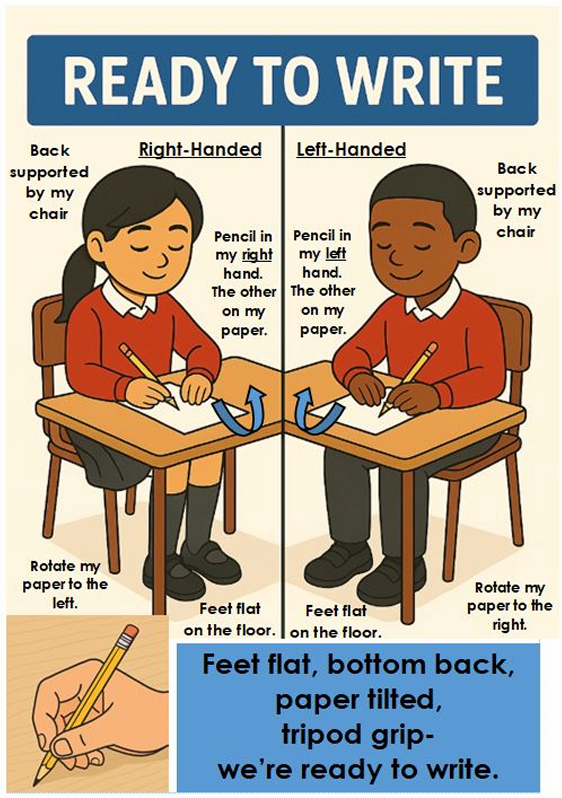
Across the school, writing lessons begin with a consistent Ready to Write routine, which ensures pupils are correctly positioned and prepared before writing begins.
This routine focuses on posture, grip and paper positioning and is explicitly taught and reinforced so that writing can be carried out comfortably, accurately and fluently. Pupils are taught to ensure:
- their back is supported by the chair
- feet are flat on the floor
- the paper is tilted appropriately
- the non‑writing hand holds the paper steady
- the pencil is held using a tripod grip
The routine is adapted appropriately for right‑handed and left‑handed writers, ensuring that all pupils are supported to write efficiently and comfortably.
In EYFS, this routine supports children as they develop a secure pencil grip and become familiar with correct posture and positioning for writing. As pupils move through the school, the Ready to Write routine ensures consistency and supports writing to become more fluent and automatic, allowing children to focus on spelling, sentence construction and composition.
Assessment and Supporting Writing Development
Assessment is used purposefully throughout the writing process. Teachers use ongoing assessment to identify pupils’ strengths and next steps, allowing teaching to be responsive, appropriately scaffolded and challenging.
Assessment information is used to:
- inform planning and teaching within writing units
- identify pupils who may need additional support or practice
- ensure learning is secure before pupils move on
This ensures that all pupils are supported to develop confidence, independence and success as writers, and that no child is moved on before they are ready.

We are proud to be part of Lincoln Anglican Academy Trust
Contact Us
St. Peter's Church of England Primary Academy
Cambridge Street
Cleethorpes
North East Lincolnshire
DN35 8LW
Cambridge Street
Cleethorpes
North East Lincolnshire
DN35 8LW