
St Peter's C of E Primary Academy
Reading at St Peter's
The Reading Fluency Bridge
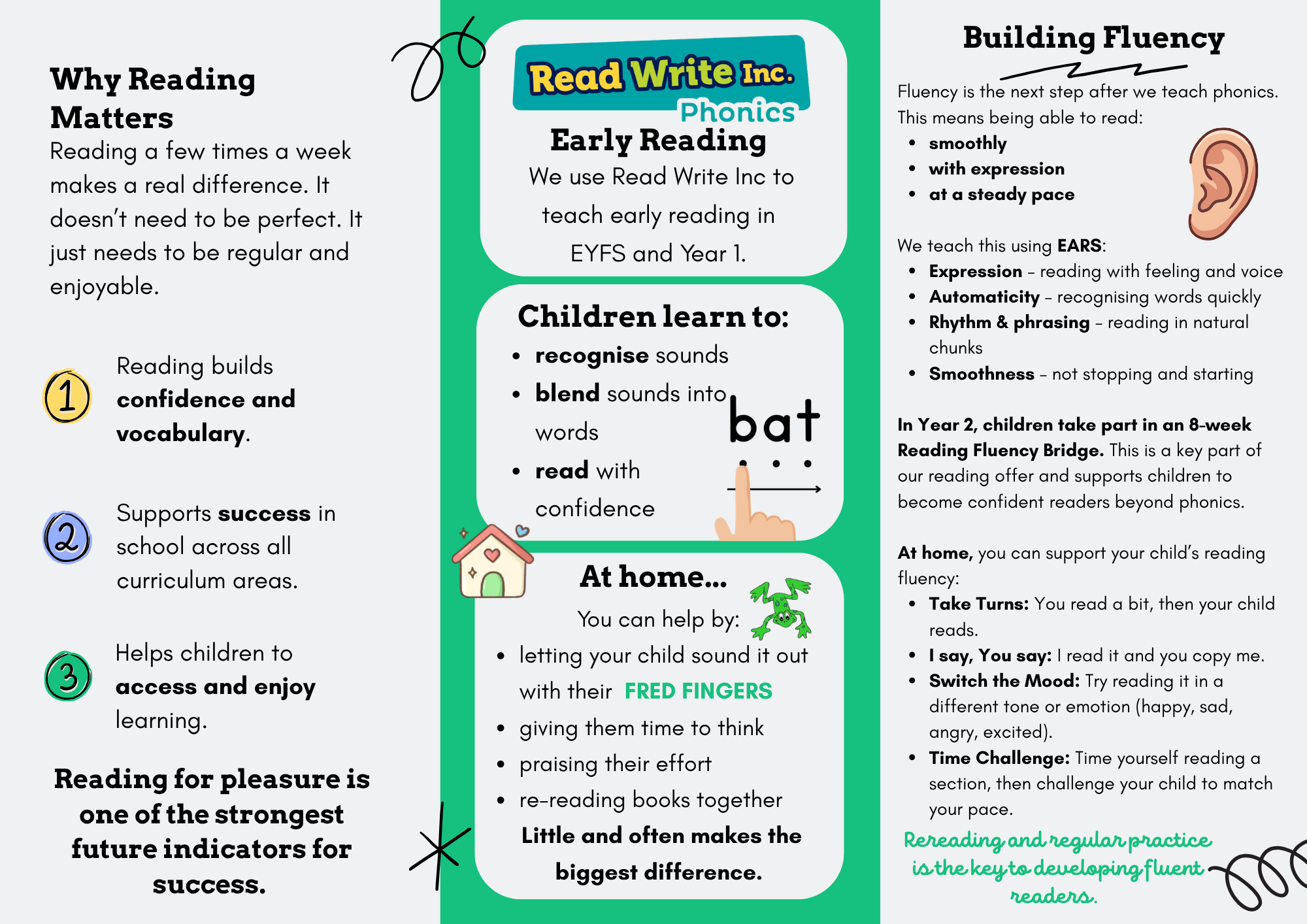
Once children have secured phonics and can accurately decode words, they move onto our Reading Fluency Bridge. This is a focused 8‑week programme that supports the transition from learning to read to reading fluently and confidently with understanding.
At this stage, the emphasis shifts from sounding out individual words to reading smoothly, accurately and with expression. We develop reading fluency using the EARS model, which focuses on:
- Expression – reading with appropriate tone and feeling, so the writing sounds interesting and meaningful
- Automaticity – recognising words quickly and accurately without needing to sound them out
- Rhythm and phrasing – reading in natural groups of words, rather than word by word
- Smoothness – reading steadily and confidently, without frequent pauses or hesitations
Children work with carefully chosen texts that increase gradually in challenge. Through listening to adults model fluent reading and rereading the same text, pupils build confidence, stamina and control over their reading.
Alongside fluency, children also develop vocabulary understanding and practise retrieval and simple inference, ensuring they are thinking carefully about meaning as well as how the text sounds.
The Reading Fluency Bridge supports children at this crucial point, helping them move successfully from decoding words to reading with ease, expression and meaning, ready for the next stage of their reading journey.
Reading After the Fluency Bridge (Year 2–Year 6)
Once children have completed the Reading Fluency Bridge, they continue their reading journey through a carefully structured, text‑led approach that develops fluency, understanding and thoughtful engagement with reading.
From Year 2 onwards, we follow the James Durran approach to reading, which places high‑quality texts, rereading, expert adult modelling and purposeful discussion at the heart of reading lessons. Children are supported to return to the same text several times so that each reread deepens fluency, understanding and response.
Each term, pupils encounter rich poetry, fiction and non‑fiction texts, carefully chosen to link with our wider curriculum. As children move through the year groups, texts increase gradually in length, linguistic complexity and depth of ideas, ensuring reading remains challenging, engaging and progressive.
Across the week, reading lessons support pupils to:
- listen to fluent adult reading that models expression, tone and meaning
- reread texts to build fluency, confidence and stamina
- explore ambitious vocabulary and language choices
- retrieve information and summarise key ideas
- develop inference by explaining ideas and justifying answers with evidence
- discuss themes, viewpoints and interpretations through structured talk
This approach supports children to become fluent, confident and reflective readers who can engage deeply with texts across the curriculum and read widely for both pleasure and purpose.
Reading for Pleasure
Alongside the teaching of reading, all children take part in 15 minutes of reading for pleasure every day. During this time, teachers read aloud a carefully chosen class text, which may include fiction, non‑fiction or poetry.
This daily reading aloud allows all children to enjoy rich language, ideas and vocabulary, and to engage with texts that may be beyond their independent reading level. It also provides a shared experience of reading, where children can listen, think and enjoy texts together.
Reading for pleasure plays an important role in developing enjoyment, curiosity and a positive reading identity, helping children to see reading as something to value and return to.
Assessment and Supporting Every Reader
Alongside ongoing teacher assessment within lessons, pupils complete termly reading assessments to help us monitor progress over time. We also use a diagnostic reading assessment tool to identify any barriers to reading, including reading rate, accuracy and comprehension.
This information is used to inform teaching and to make well‑considered decisions about the most appropriate intervention and support, ensuring that every child is supported to continue making progress as a reader and experiences success.
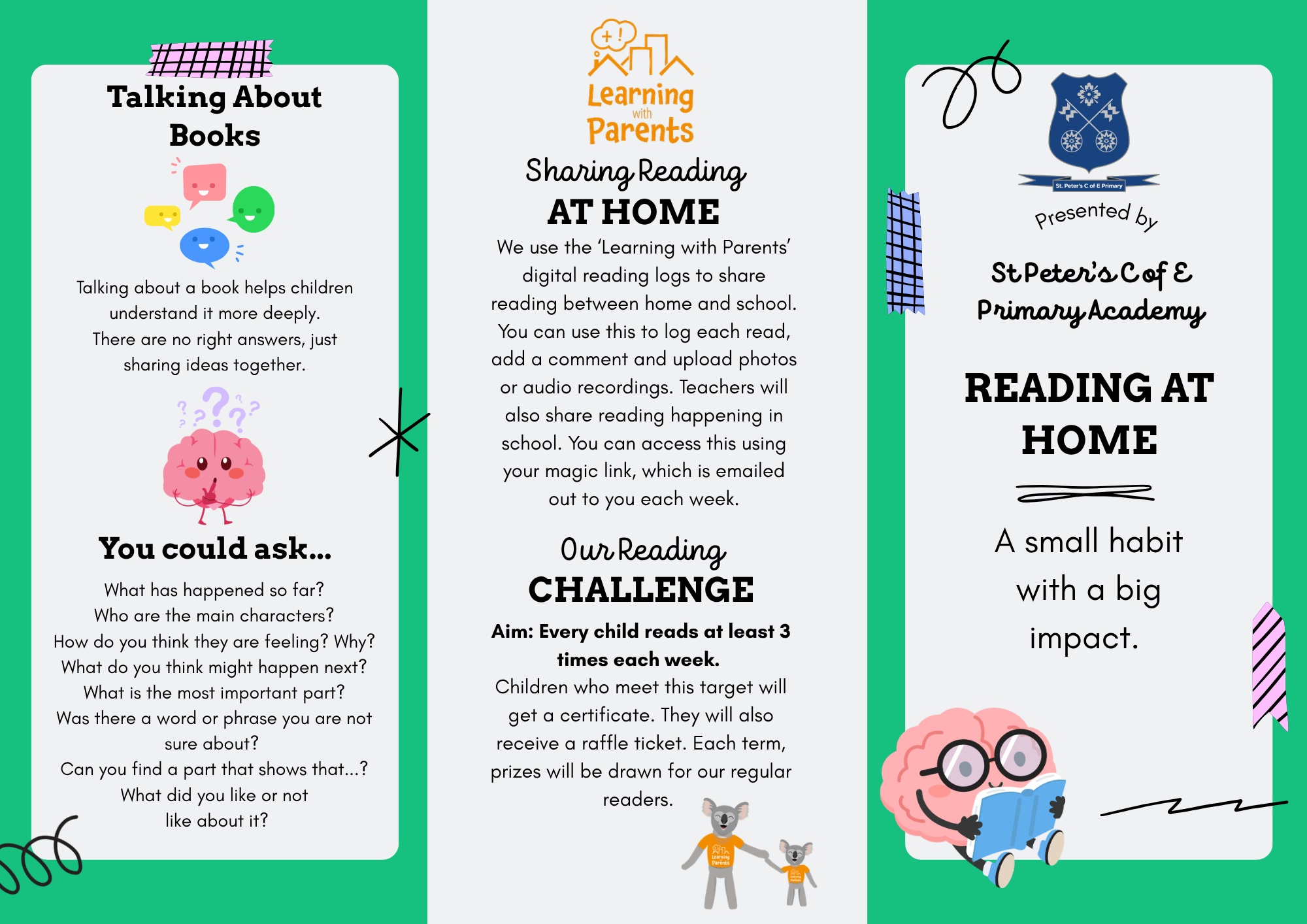
Reading at Home
As children move beyond phonics, reading at home continues to play an important role in developing fluency, confidence and understanding. Regular reading helps children practise their skills and builds a positive reading habit.
We use the Learning with Parents digital reading log to share reading between home and school. Families can log each read, add a short comment and, if they wish, upload photos or audio recordings. Teachers also use the log to share reading that takes place in school.
Our aim is for every child to read at least three times each week. Further guidance, ideas for supporting fluency, and suggested questions to talk about books can be found in the Reading at Home leaflet, which explains our approach in more detail.
'Once you learn to read, you will forever be free'
Frederick Douglass- who was born into slavery and believed reading could change lives.

We are proud to be part of Lincoln Anglican Academy Trust
Contact Us
St. Peter's Church of England Primary Academy
Cambridge Street
Cleethorpes
North East Lincolnshire
DN35 8LW
Cambridge Street
Cleethorpes
North East Lincolnshire
DN35 8LW